
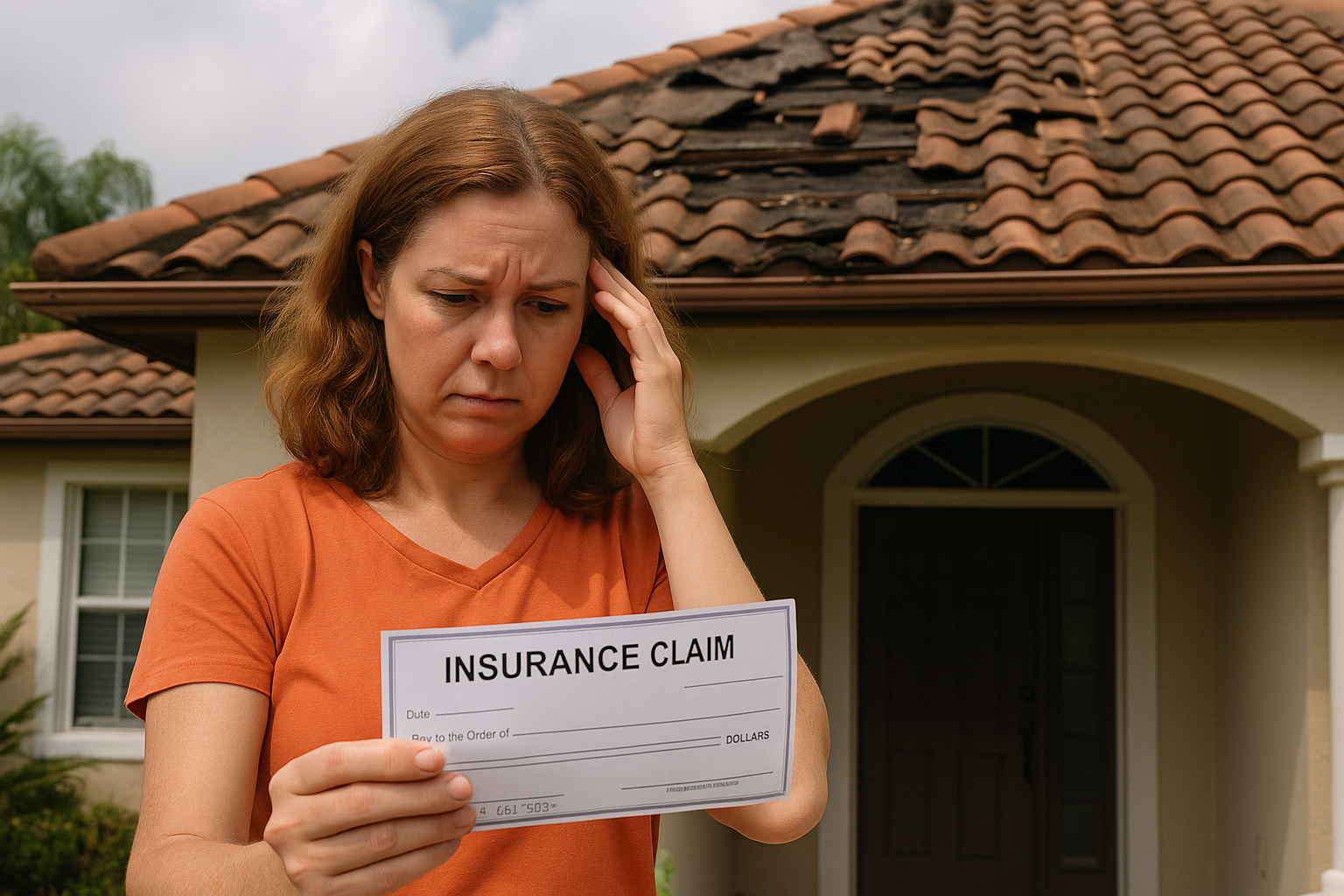
A Florida homeowner reviews her insurance claim check, only to realize it falls far short of the actual roof repair costs. Many people assume their homeowners insurance will fully cover any storm damage to their roof. This assumption creates an illusion of full coverage – the belief that you’ll only pay your deductible and insurance will handle the rest. In reality, Florida homeowners often discover that their insurance payout doesn’t come close to the true cost of proper roof repairs or replacement.
The Illusion of Full Coverage
Insurance policies are filled with limits and exclusions that can leave you holding a big bill. Yes, your policy likely covers sudden storm damage (like wind tearing off shingles or a fallen tree). But if your roof was already old or not up to today’s building code, the insurer might deny or reduce coverage. Even when the damage is covered, the check you get may not equal the actual repair cost. Insurance companies subtract for depreciation and apply deductibles, which can dramatically shrink your payout. For example, if a full roof replacement costs $25,000, an insurer might only offer around $14,000 after factoring in depreciation – and that’s before taking out your deductible. This means a homeowner expecting a fully paid new roof could be blindsided by a huge shortfall.
Florida’s insurance rules have also changed in recent years, making full coverage even harder to get. Until 2022, if more than 25% of your roof was damaged, insurers usually paid to replace the whole roof. Now they often only pay for patching the damaged portion if the rest of the roof is still up to code. In practice, that could leave you with mismatched old and new sections – or force you to pay out of pocket to replace the remainder of the roof for a uniform, safe repair. After major hurricanes, the gap between what repairs cost and what insurance pays becomes especially clear. In the aftermath of 2022’s Hurricane Ian, many Florida homeowners were drastically underpaid, receiving barely a fraction of what they needed to rebuild. In short, having insurance is not a guaranteed blank check for roof damage. You might think you’re fully protected, but limited coverage, depreciation, high deductibles, and new policy loopholes can leave you far from fully covered.
Why Insurance Inspections Miss the Mark
One big reason insurance payouts fall short is that initial inspections often miss significant damage. After a hurricane or big storm, insurance adjusters in Florida are swamped with claims. They may spend only a few minutes looking at your roof when a careful inspection would take hours. Important problems can be overlooked – things like water seeping under shingles, soaked insulation, cracked roof decking, or internal leaks that aren’t obvious from a quick glance. Some damage (like wood rot or hidden mold) might not show up immediately, so if the inspection is rushed or superficial, those issues get left out of the insurance estimate.
In fact, many insurance adjusters never even climb onto the roof. It’s increasingly common for insurers to do “drive-by” assessments or rely on drones and computer models instead of a thorough in-person check. We’ve seen cases where an adjuster writes an estimate from behind a computer, using software algorithms and outdated price lists – without ever setting foot on the property. These limited inspections often miss code-related damage and structural issues that a contractor would catch. For example, an adjuster’s report might quote for replacing a few shingles, not realizing that the roof’s underlayment is ruined or that the whole section needs re-framing to meet code. If the insurance company’s inspection is incomplete, their payment will be incomplete too. They might conclude your roof only needs minor fixes when in reality a much bigger repair (or even a full replacement) is required for safety and code compliance. The result? The insurance check comes up thousands of dollars short, and the homeowner is left scrambling to cover the difference.
The Pitfalls of Chasing Low Bids
When faced with a skimpy insurance payout, many homeowners try to solve the problem by hunting for the cheapest contractor who’ll do the work for the amount the insurer offered. It’s understandable – you don’t want to pay more out of pocket than necessary. But chasing low bids can backfire in a big way. The lowest quote might come from an inexperienced or corner-cutting crew. If a contractor agrees to replace your roof for an unusually low price, they have to cut costs somewhere. That often means using inferior materials, unlicensed labor, or skipping important steps. You might end up with subpar shingles that aren’t rated for Florida’s hurricane winds, or shortcuts in installation (like fewer nails or missing waterproof layers). These shortcuts can void your warranty and even violate building codes.
Going with the bargain option can leave you with a roof that looks fixed but isn’t truly sound. Even worse, if the roofer skips pulling permits or fails to do work up to Florida’s strict code, you could hit trouble down the road. A quick fix that doesn’t meet code might jeopardize future insurance claims – the next time you have damage, your insurer could refuse to pay for a roof that wasn’t repaired properly or legally. In Florida, insurers can deny claims if previous work was done without permits or failed inspections. So, that rock-bottom bid could cost you much more in the long run. As a rule of thumb: you get what you pay for. One Florida roofing expert warns that cheap bids often come with shoddy workmanship and shortcuts that don’t meet code. Instead of saving money, you could end up with ongoing leaks, repairs, or even having to redo the entire job with a new contractor – all out of pocket. It’s far safer to choose a reputable, licensed roofer who will do it right and stand by their work. If the insurance money isn’t enough, you’re better off negotiating for a higher payout (or arranging financing for the gap) than risking a low-quality repair.
What “Out-of-Pocket” Really Means
When your insurance company says you’re covered for roof damage, it’s easy to assume the only cost you’ll pay is your deductible. The deductible is the portion of the claim you pay yourself (often a set amount like $2,000 or a percentage of your home’s value). But the truth is, if your claim is underpaid, “out-of-pocket” can go way beyond that deductible. Essentially, any shortfall between the real repair cost and the insurance payment comes out of your pocket. If your insurer only approves, say, $10,000 for a job that actually costs $20,000, that extra $10k has to be paid by you. Instead of just the small deductible you expected, you could be on the hook for thousands more.
Why does this happen? As discussed, insurance estimates often omit or underprice a lot of necessary work. Many homeowners only discover this when the contractor explains the full scope of repairs. For instance, your insurance might pay to replace damaged shingles but not the cost of replacing rotted plywood decking underneath, or the higher expense of shingles that meet the latest wind-resistance code. Common expenses like gutter removal and reinstallation, interior water damage repairs, permit fees, or debris disposal might be excluded from the insurance check. But these are real parts of a proper roof restoration, and if they’re not covered, you’ll have to cover them. Florida policyholders have frequently found themselves in this predicament: paying not just a deductible but significant sums to finish the job right. In fact, many families hit by storms have ended up living under leaky tarps or unsafe conditions because they can’t afford to fully repair their roofs with the limited insurance money. “Out-of-pocket” can mean dipping into savings, taking loans, or charging credit cards to make up for an insurance shortfall. It’s a frustrating situation – you’ve faithfully paid your premiums, only to face unexpected costs when you need your coverage the most.
Protecting Yourself From Underpaid Claims
The good news is that homeowners are not helpless. There are steps you can take before and after an insurance claim to protect yourself from underpayment. Here are some actionable tips to ensure you get the fairest possible outcome:
-
Get a Thorough Roof Inspection: Don’t rely solely on the insurance adjuster’s quick look. After any major storm or if you suspect damage, have a qualified professional inspect your roof in detail. A reputable roofing contractor or licensed public adjuster will document all damage, including hidden issues (like soaked insulation or sub-roof wood rot) that an insurance adjuster might miss. Detailed photo evidence and a comprehensive report will make it harder for the insurer to overlook necessary repairs.
-
Document Everything: Take clear photos and videos of all damage as soon as it’s safe to do so. Capture wide shots and close-ups of missing shingles, dents, leaks, and interior water stains. Make a list of damaged areas. The more evidence you have, the stronger your claim. It’s also wise to keep records of your roof’s condition before any storm (if possible) to prove the damage wasn’t pre-existing. Good documentation can prevent the “it’s not that bad” or “it was already old” excuses that insurers use to pay less.
-
Know Your Policy (and Your Rights): Take time to read through your homeowners insurance policy, especially the sections on roof coverage. Is your roof insured for replacement cost or actual cash value (depreciated value)? Does your policy include Ordinance or Law coverage (which pays for code-required upgrades)? Knowing this info upfront helps you understand what the insurer should pay. For example, if you have replacement cost coverage, you’re entitled to the full cost of a new equivalent roof (minus deductible) – don’t let them only pay the depreciated amount of your old roof. Also be aware of Florida’s claim laws: you generally have one year from the date of the damage to file a claim, so don’t wait too long or you could lose your rights.
-
Compare Independent Estimates: Before settling for the insurance company’s figure, get a couple of quotes from licensed roofing contractors. Make sure these estimates are detailed, including all materials, labor, and code-required work (like updated flashing or stronger shingles). Often, you’ll find the contractor estimates are much higher than the insurer’s offer – concrete proof that the insurance payout isn’t sufficient. You can provide these estimates to your insurance company to argue for a higher payment. It shows what reasonable and customary costs truly are in your area, countering any lowball numbers the adjuster used.
-
Don’t Settle for Less – Speak Up: If you receive a low initial offer, you have the right to dispute or negotiate it. You can ask for a re-inspection or file a supplemental claim for items that were overlooked. Write a polite but firm letter (or email) to your insurer detailing the discrepancies – for instance, “Your estimate didn’t include replacing the damaged plywood or the gutters. These are required to restore the roof.” Back it up with your evidence and contractor reports. If they still won’t budge and you truly believe you’re entitled to more, consider getting a licensed public adjuster or an insurance attorney involved. Public adjusters are professionals who work on your behalf (not the insurance company) to negotiate claims, and they are especially useful in complex or high-value claims. Florida regulators also suggest filing a complaint with the state Department of Financial Services if an insurer is acting unfairly. Remember, the squeaky wheel gets the grease – you can push back to get what you’re owed.
By taking these steps, you greatly increase the chances that your claim will be paid fully and fairly. The key is to be proactive and informed. Don’t be afraid to ask questions and insist on the coverage you paid for. In an insurance claim, knowledge is power – and it can save you thousands of dollars out of pocket.
How we can help!
Dealing with an underpaid roof claim can feel overwhelming, but you don’t have to go it alone. Orange Contracting is here to help Florida homeowners navigate this tricky process and ensure your roof is restored properly without leaving you in financial pain. We’re not just roofing contractors – we have licensed public adjusters on staff who specialize in insurance claims. This means when you work with Orange Contracting, you get the best of both worlds: skilled roofing professionals and knowledgeable claims experts in one team.
Our experienced staff will advocate for you from start to finish. We thoroughly inspect your roof damage (often finding issues insurance adjusters overlook) and provide a detailed, honest estimate for the full scope of work. Because we understand Florida building codes and insurance practices, we know how to document damage and justify the repairs your home truly needs. Orange Contracting’s adjusters can communicate directly with your insurance company to negotiate a fair settlement – one that covers all the necessary repairs and code upgrades, not just a quick patch job. Our goal is simple: to make sure you get every dollar you’re entitled to for a safe, quality roof restoration.
Don’t risk your home by settling for a minimal payout or a subpar repair. Let Orange Contracting put our unique expertise to work for you. We’ve helped countless homeowners in Florida get full and fair results from their insurance claims, saving them from paying big bucks out of pocket. Your home is your biggest investment, and we believe you deserve the peace of mind that it’s fully protected.
Contact Orange Contracting today to schedule a free roof inspection or claim consultation. We’ll guide you through the process, fight for your rights as a policyholder, and ensure your new or repaired roof meets the highest standards of quality and safety. With Orange Contracting by your side, you can turn a frustrating insurance experience into a successful roof restoration. Don’t wait – reach out now and let us help you get the coverage you deserve.
Call Orange Contracting and Roofing at 407-205-2676 or email [email protected]
The company’s office is located at 105 Candace Dr., Suite 129, Maitland, FL 32751.