
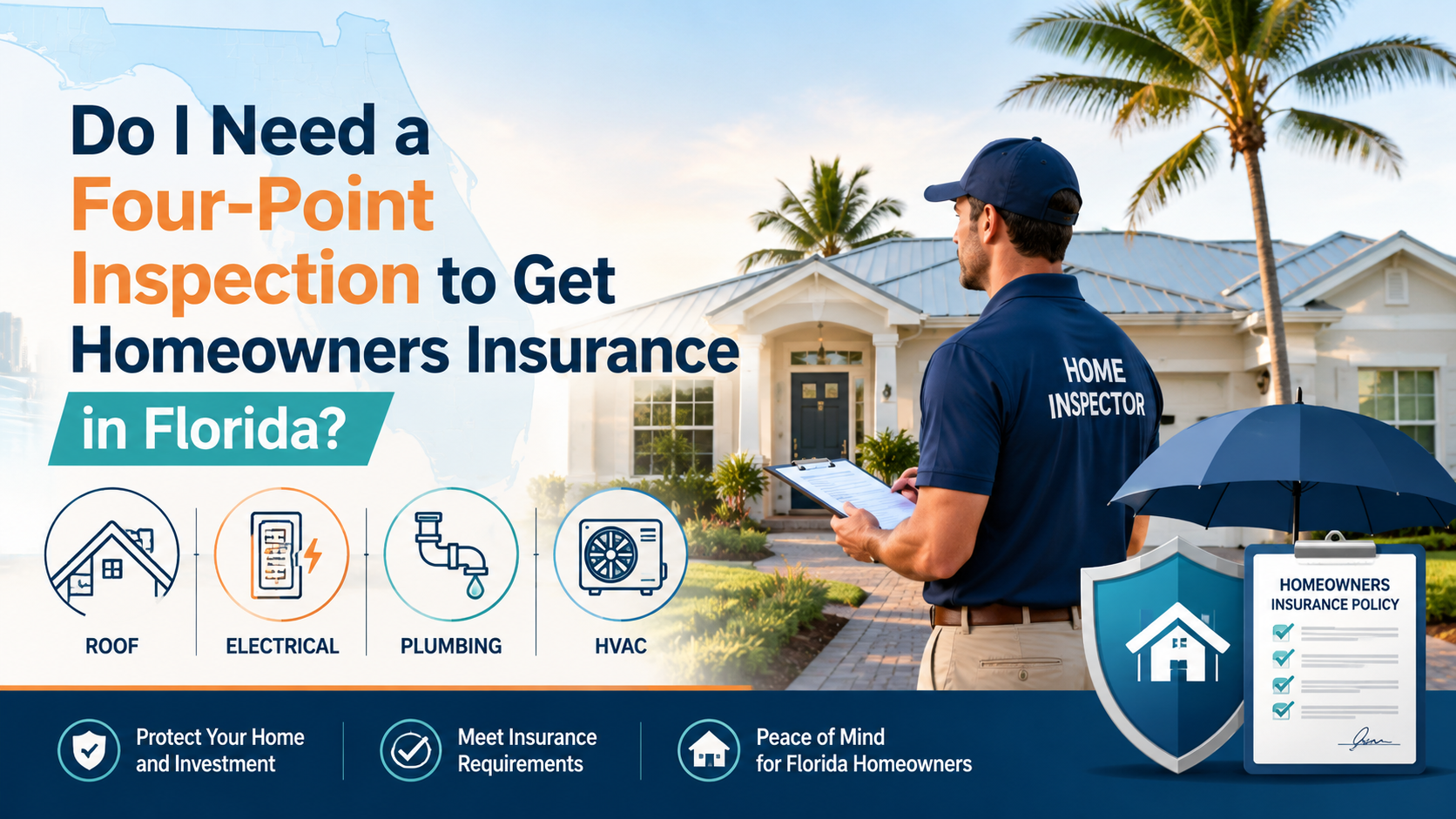
You’re shopping for homeowners insurance in Florida — or renewing your current policy — and your agent tells you they need a “four-point inspection” before the carrier will issue coverage. If you’ve never heard of one, or you’ve heard the term but don’t know what it involves, you’re not alone.
A four-point inspection is one of the most common requirements in the Florida insurance market, and for older homes, it’s often the single document standing between you and a policy. Here’s what it is, when you need one, what the inspector is looking for, and — most importantly — what happens when something on the report raises a red flag.
What Is a Four-Point Inspection?
A four-point inspection is a focused evaluation of four major systems in your home:
Roof — age, material, condition, and estimated remaining useful life.
Electrical — panel type, wiring material, age, and overall safety.
Plumbing — pipe material, water heater age and condition, and evidence of leaks.
HVAC — heating and cooling equipment age, type, condition, and functionality.
That’s it. It’s not a full home inspection. The inspector isn’t checking your foundation, your windows, your insulation, or your appliances. They’re evaluating only the four systems that generate the most insurance claims and the highest-cost losses. The goal is to give the carrier enough information to decide whether your home is a risk they’re willing to underwrite.
A typical four-point inspection takes 30 to 60 minutes and costs between $75 and $200 in most Central Florida markets.
When Is a Four-Point Inspection Required?
There’s no single state-mandated threshold — each carrier sets its own underwriting guidelines. But the general patterns in 2026 are fairly consistent:
Citizens Property Insurance requires a four-point inspection for all homes more than 20 years old before it will issue a new policy. Any serious deficiency — active leaks, exposed wiring, a roof with fewer than three to five years of remaining useful life — will result in a denial until the issue is corrected.
Private carriers vary. Some require a four-point at 20 years, some at 25, and some at 30. A few carriers have loosened their thresholds in 2026 as competition has increased in the Florida market, but the majority still require the inspection for homes in the 20-to-30-year range.
When switching carriers, most new insurers will require a current four-point regardless of whether your previous carrier had one on file.
When buying a home, the buyer’s insurance company will almost always require a four-point on any home over 20 years old before binding coverage. This is separate from the buyer’s standard home inspection and covers a much narrower scope.
The short answer: if your home is 20 years old or older and you’re applying for a new policy or switching carriers, expect to need one.
What the Inspector Looks for in Each System
Roof
The roof section carries the most weight on the report, especially in Florida. The inspector documents the roofing material (shingles, tile, metal), the approximate age of the current roof covering, its visible condition from a ground-level or ladder-edge observation, and — critically — the estimated remaining useful life.
Insurance carriers in Florida generally want to see a minimum of five years of remaining useful life on the roof. If the inspector determines the roof has fewer than five years left, or documents significant deficiencies like missing shingles, visible deterioration, active leaks, or evidence of prior patching, the carrier will likely require a roof replacement before issuing coverage.
This is where many homeowners hit a wall. The house is otherwise in good shape, but the roof is 18 or 22 years old, showing age, and the four-point report comes back with a limited remaining life estimate. The carrier won’t write the policy until the roof is addressed.
If you’re in this situation, a roof replacement solves the four-point issue and also opens the door to significant wind mitigation credits that can reduce your annual premium by hundreds or thousands of dollars. A new code-compliant roof with a proper underlayment system doesn’t just get you insurable — it gets you insurable at a better rate.
If your roof has storm damage that accelerated its deterioration, the replacement may be partially or fully covered by your current insurance policy. It’s worth having both the damage and the policy reviewed by a licensed public adjuster before paying out of pocket for what might be an insurable loss.
Electrical
The inspector checks the electrical panel manufacturer and age, the type of wiring in the home (copper vs. aluminum), the overall condition of visible wiring, and whether any obvious hazards exist.
Two specific findings will cause problems with almost every Florida carrier:
Federal Pacific or Zinsco panels. These panel brands have well-documented failure rates and are considered a fire risk. Most carriers will not insure a home with either panel type, regardless of age or condition. Replacement is typically the only path to coverage.
Aluminum wiring. Common in Florida homes built between the mid-1960s and mid-1970s, aluminum wiring is a known fire hazard at connection points. Some carriers will accept aluminum wiring if it has been properly remediated with approved copper pigtails at all connections, but many will decline coverage entirely until the wiring is updated.
If your panel or wiring is flagged, you’ll need a licensed electrician to address the issue before the carrier will proceed.
Plumbing
The inspector documents the pipe material throughout the home, the water heater’s age and condition, and whether there’s any evidence of leaks — active or historical.
The biggest red flag is polybutylene piping, a gray plastic pipe material used extensively in Florida homes built between the late 1970s and mid-1990s. Polybutylene is prone to brittle failure at fittings and connections, and many Florida carriers will not insure a home with polybutylene supply lines. Replacement with copper or PEX is typically required.
Galvanized steel pipes in older homes also raise concerns due to corrosion and reduced water flow, though they’re less of an automatic decline than polybutylene.
Water heater age matters too. Most carriers want the water heater to be under 15 to 20 years old. An aging water heater — especially one with visible corrosion, improper drain pan installation, or no pressure relief valve discharge pipe — can trigger a requirement for replacement.
HVAC
The inspector evaluates the age, type, and condition of your heating and cooling system. Florida carriers generally want to see a functional central air conditioning system (window units alone may not satisfy some underwriters) and equipment that’s in reasonable working condition.
HVAC is typically the least problematic section of the four-point for most Florida homes, but an extremely old system (20+ years) or one with visible issues like refrigerant leaks, electrical hazards, or non-functional components can be flagged.
What Happens If Something Fails?
A four-point inspection doesn’t have a formal “pass” or “fail” — it’s a report, not a test. But in practical terms, the carrier reads the report and makes a coverage decision based on what it says. If a system has a deficiency the carrier considers unacceptable, they’ll either decline to write the policy or issue a conditional requirement: fix the issue and provide documentation, then they’ll proceed.
For roof-related issues, the path forward is usually clear: replace the roof, provide the closed permit and final inspection documentation, and resubmit to the carrier. For the other three systems, you’ll need the appropriate licensed professional — electrician, plumber, or HVAC technician — to make the repair and provide documentation.
The timeline matters. If you’re buying a home and need insurance bound by closing, a four-point deficiency can delay the transaction. The sooner you schedule the inspection, the more time you have to address any issues before they become a closing problem.
Four-Point vs. Wind Mitigation: Two Different Inspections
Homeowners frequently confuse these two inspections, but they serve completely different purposes.
The four-point inspection determines whether your home is insurable — whether the carrier will write a policy at all. It’s a gatekeeping document.
The wind mitigation inspection determines how much you’ll pay for that policy. It evaluates hurricane-resistance features — roof shape, roof-to-wall connections, deck attachment, secondary water resistance, and opening protection — and generates premium credits that reduce the windstorm portion of your policy.
You may need one or both. If your home is over 20 years old, plan on scheduling both at the same time — many inspectors offer a bundle discount, and having both reports ready when you apply for coverage avoids back-and-forth delays with your agent.
How a New Roof Affects Your Four-Point
Of the four systems evaluated, the roof is the one most likely to trigger a coverage requirement — and it’s also the one where the fix produces the biggest downstream benefits.
When you replace your roof with a licensed, permitted contractor, the four-point report goes from a potential liability to a strength. Instead of documenting a 20-year-old roof with limited remaining life, the inspector documents a brand-new roof covering with a full lifespan ahead of it, installed under a closed building permit to current Florida Building Code standards.
But it goes further than just satisfying the four-point. A new roof also:
- Qualifies for the roof covering credit on your wind mitigation form
- Brings deck attachment up to current code (8d nails, 6” on center in the field)
- Creates the opportunity to install a sealed roof deck for the SWR insurance credit
- Resets the roof age clock, protecting you from age-based non-renewal for the next 15 to 25 years
- May qualify for My Safe Florida Home grant funding if the project includes eligible hurricane-hardening improvements
In other words, the four-point inspection often reveals what you already suspected — your roof needs attention — and a proper replacement solves the insurance problem while generating savings that persist for years.
When to Involve a Public Adjuster
If your roof is failing the four-point and you suspect that storm damage — not just age — contributed to its current condition, don’t assume you have to pay for the replacement out of pocket.
Storm damage can accelerate a roof’s deterioration in ways that aren’t always obvious from the ground. Wind can break shingle seals without visibly displacing the shingle. Hail can bruise shingles and crack tiles in patterns that look like aging to an untrained eye. These are insurable losses, and your current homeowners policy may cover a replacement that the four-point inspection is now requiring.
Before you pay retail for a new roof, have the damage evaluated by both a licensed roofing contractor and a licensed public adjuster who can review your policy and determine whether a claim is warranted. NeJame Claims Adjusting handles this exact scenario for Central Florida homeowners — inspecting the roof, reviewing the policy, and pursuing the claim if the damage is insurable. They work on a contingency basis, so there’s no cost unless they recover proceeds on your behalf.
The worst-case outcome is confirmation that the damage is age-related and you need to pay for the replacement yourself. The best-case outcome is that your insurance covers most or all of it — and you would have never known without asking.
What to Do Next
If you’re facing a four-point inspection and you’re concerned about your roof, the smartest first step is a professional inspection from a licensed roofing contractor. We’ll tell you honestly whether your roof is likely to pass, whether storm damage may be a factor, and what your options are — including financing if a replacement is needed.
Start with our free Instant Estimate tool for a preliminary price range, or contact us directly to schedule an inspection.
Call us at 407-205-2676 or reach out online.