
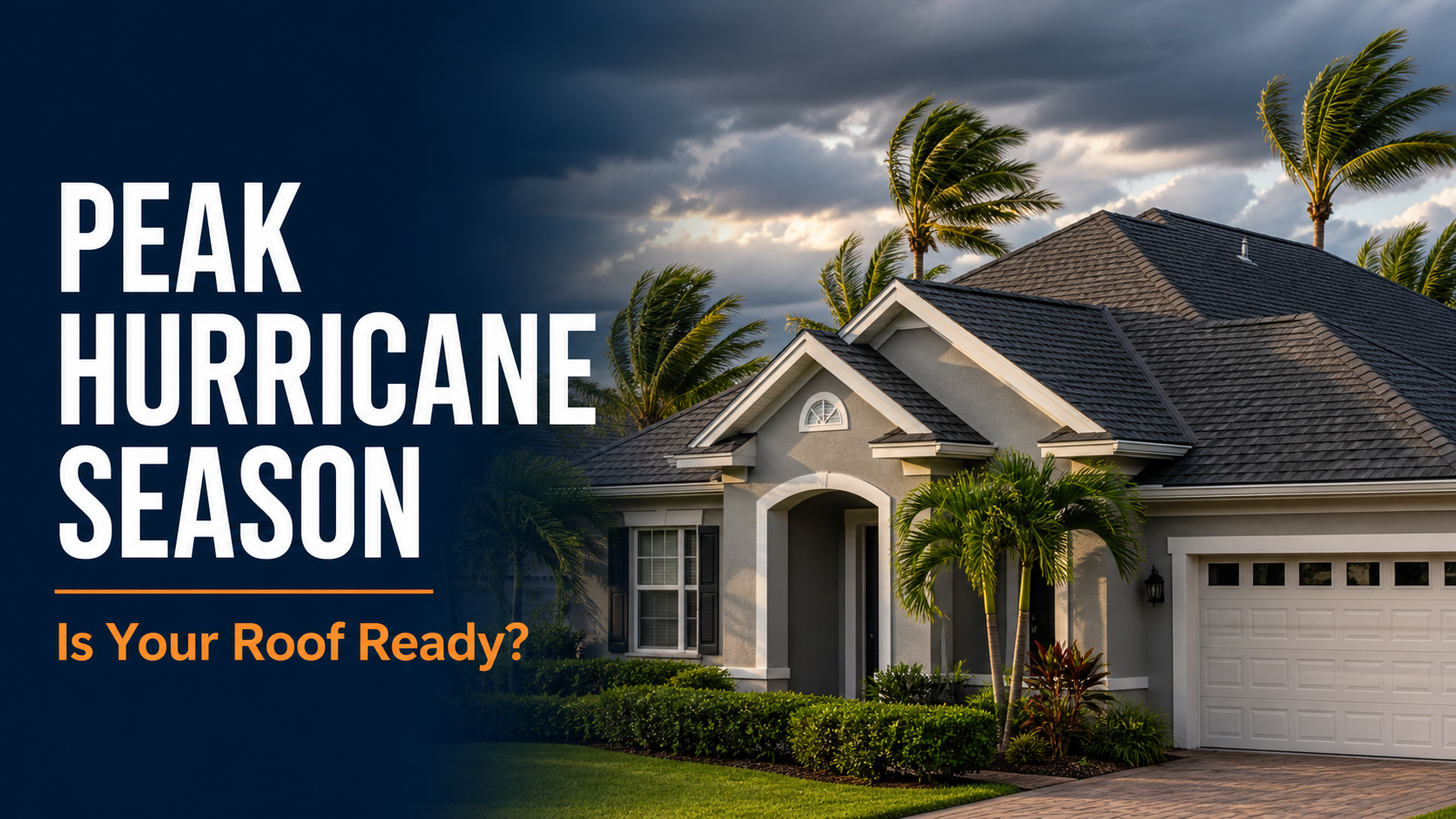
Back on June 1, we published a full pre-season readiness guide. If you worked through that checklist, you’re in good shape, and this post is a short refresher.
If you didn’t, you’re not alone, and you haven’t missed your window. But it’s narrowing.
Hurricane season runs June 1 through November 30, and that range hides something important: the season is not evenly distributed. Activity climbs sharply through late August, peaks in the first half of September, and stays elevated deep into October. For homeowners in Orange, Seminole, Osceola, Lake, Volusia, Polk, and Brevard counties, the next several weeks are the part of the year your roof is most likely to be tested.
A quiet forecast doesn’t change that. In its August update, NOAA maintained its below-normal outlook for the 2026 season, and we’ve written before about why a low storm count is not the same as a low-risk season. It only takes one.
Here’s the compressed version of what still matters.
1. Look at your roof from the ground, on purpose
Not a glance on the way to your car. Walk the full perimeter with your phone and actually look up.
You’re looking for anything that breaks the plane of the roof or interrupts a clean, uniform surface:
- Missing, lifted, or curling shingles. Any shingle not lying flat is a place wind can get underneath. Wind damage can spread from one loose shingle to a much larger area.
- Dark patches or streaking that look different from the surrounding field. Sometimes that’s algae, which is cosmetic and common here. Sometimes it’s granule loss, which is not. Our post on shingle rejuvenation covers what granule loss actually means for an aging roof.
- Sagging or wavy lines along the ridge or between rafters, which may suggest a structural or moisture-related problem underneath.
- Damaged or separated flashing around chimneys, skylights, and vent pipes. A surprising share of leaks start at flashing rather than in the field of the roof.
- Granules in your gutters or at the base of downspouts. A little is normal on a newer roof. A large or increasing amount can mean the shingle surface is wearing through.
Take photos while you’re out there. Date-stamped images of your roof in known condition are genuinely useful later—they’re the baseline that makes a post-storm assessment meaningful instead of guesswork.
2. Clear your gutters and check your drainage
Central Florida tropical systems are, more than anything else, rain events. A storm doesn’t have to reach hurricane strength to drop several inches in a few hours.
Clogged gutters can back water up at the roof edge and contribute to fascia, soffit, or interior damage. Insurance coverage for maintenance-related damage may be limited or excluded, depending on the policy and circumstances. Clean gutters are one of the least expensive forms of protection a homeowner has. Our guide to the systems working alongside your roof covers how gutters, soffit, and fascia function together.
While you’re at it, make sure downspouts discharge away from the foundation rather than into a bed against the house.
3. Deal with your trees now
This is the item people put off, and it can cause severe damage.
Look for limbs overhanging the roof, dead or dying branches anywhere in the canopy, and trees leaning toward the structure. In sustained wind, an overhanging limb doesn’t have to break off to cause problems. It can abrade the shingle surface for hours, stripping granules and working fasteners loose.
Schedule tree work well ahead. Once a storm is in the forecast, crews across Central Florida book quickly.
4. Secure everything not attached to the ground
Patio furniture, grills, umbrellas, planters, trampolines, trash bins, and pool equipment can become projectiles in tropical-storm-force winds. A meaningful share of roof punctures comes from windborne yard debris rather than wind pressure alone.
Know where these things will go before you need to move them, and be honest with yourself about whether you can move them alone. FEMA’s hurricane preparedness page is a useful general checklist for the non-roof side of this, and FloridaDisaster.org provides evacuation-zone and statewide preparedness resources.
5. Check your soffit and fascia
Soffit is the underside of your roof overhang, and it’s a common failure point in Florida homes. When soffit panels blow out, wind and water can get directly into the attic, allowing damage to spread to insulation, ceilings, and drywall.
Walk the perimeter and look for panels that are loose, sagging, gapped, or missing. That is often straightforward to repair now and a much bigger job after a storm.
6. Get a professional inspection if your roof is over 10 years old
An asphalt shingle roof in Central Florida works under conditions most of the country doesn’t deal with—intense UV, high humidity, and daily thermal cycling all summer. Our Florida Roof Lifespan Calculator gives you a rough sense of where yours stands in about a minute.
If your roof is past ten years old, has never been inspected, or went through a named storm and was never looked at afterward, it’s worth having someone qualified inspect it. Plenty of real damage is invisible from the driveway: lifted nail heads, compromised seal strips, soft decking, and separated flashing.
There’s an insurance dimension here too. Roof age drives coverage decisions in this state, and we’ve covered both how Florida’s 15-year roof rule actually works and what a four-point inspection looks for. If an inspection turns up enough that you’re weighing options, our guide to repair versus full replacement walks through how to make that call.
Worth knowing: the My Safe Florida Home program may provide wind-mitigation inspections and grants for eligible homeowners when application windows and funding are available. Program availability changes quickly, so check the official program status before relying on it for your project timeline or budget.
7. Get your paperwork in order
Not roofing work exactly, but it belongs on the list:
- Find your policy and read your wind and hurricane deductible. In Florida, this is often a percentage of dwelling coverage rather than a flat dollar figure, which catches many people off guard. Our plain-English guide to reading a Florida homeowners policy walks through where to find it.
- Understand whether your roof is covered at replacement cost or actual cash value. The difference can be many thousands of dollars, and ACV roof schedules have become common in Florida policies.
- Note your roof’s age and material and locate the original installation paperwork.
- Save your photos somewhere that isn’t only on your phone.
- Keep your insurer’s claims number somewhere reachable without power or internet.
A note on what comes after
If a storm does affect your area, be deliberate about who you let on your roof afterward.
Verify that anyone you hire holds a current Florida license—you can check contractors directly through the Florida DBPR license search—and confirm they carry insurance. Be cautious with crews that show up unsolicited in the days after an event.
If you do end up with damage, we’ve written the process out step by step: what to do in the first 48 hours, what emergency tarping costs and what your carrier may reimburse, and the full hurricane claim filing guide. Florida also gives homeowners specific protections during a claim, which we’ve laid out in our guide to the Homeowner Claims Bill of Rights.
Where to watch the tropics
Two sources are worth bookmarking for the rest of the season:
- News 6 Tropics Watch—WKMG’s Central Florida tropical coverage, with local context on what a system may mean for our area rather than for the coast generally.
- National Hurricane Center—the official source for advisories, forecast cones, and the tropical weather outlook, updated regularly throughout hurricane season.
We’re here if you need us
Orange Contracting and Roofing is a licensed Florida roofing, residential, and general contractor serving Central Florida from our office in Maitland. If you’d like your roof looked at before the peak of the season, get in touch—or if you’re just curious where you stand, our Instant Estimate tool gives you a preliminary number in a couple of minutes using satellite imagery, with no appointment needed.
You can also read about how we work before you call.
Contact Orange Contracting and Roofing
- Company: Orange Contracting and Appraisal, Inc., DBA Orange Contracting and Roofing
- Address: 105 Candace Dr., Suite 129, Maitland, FL 32751
- Phone: 407-205-2676
- Email: [email protected]
- Web: myorangecontracting.com · Free Instant Estimate · Contact Form
- Licenses: Certified Roofing Contractor CCC1337502 · Certified Residential Contractor CRC1336049 · Certified General Contractor CGC1540193
- Service area: Orange, Seminole, Osceola, Lake, Volusia, Polk, and Brevard counties—including Orlando, Maitland, Winter Park, Altamonte Springs, Longwood, Lake Mary, Oviedo, Apopka, Sanford, Kissimmee, and Winter Garden
- Follow us: Facebook · Instagram · X · YouTube
This article provides general information about roof maintenance and hurricane preparation. Insurance coverage depends on the policy language and facts of a specific loss.