
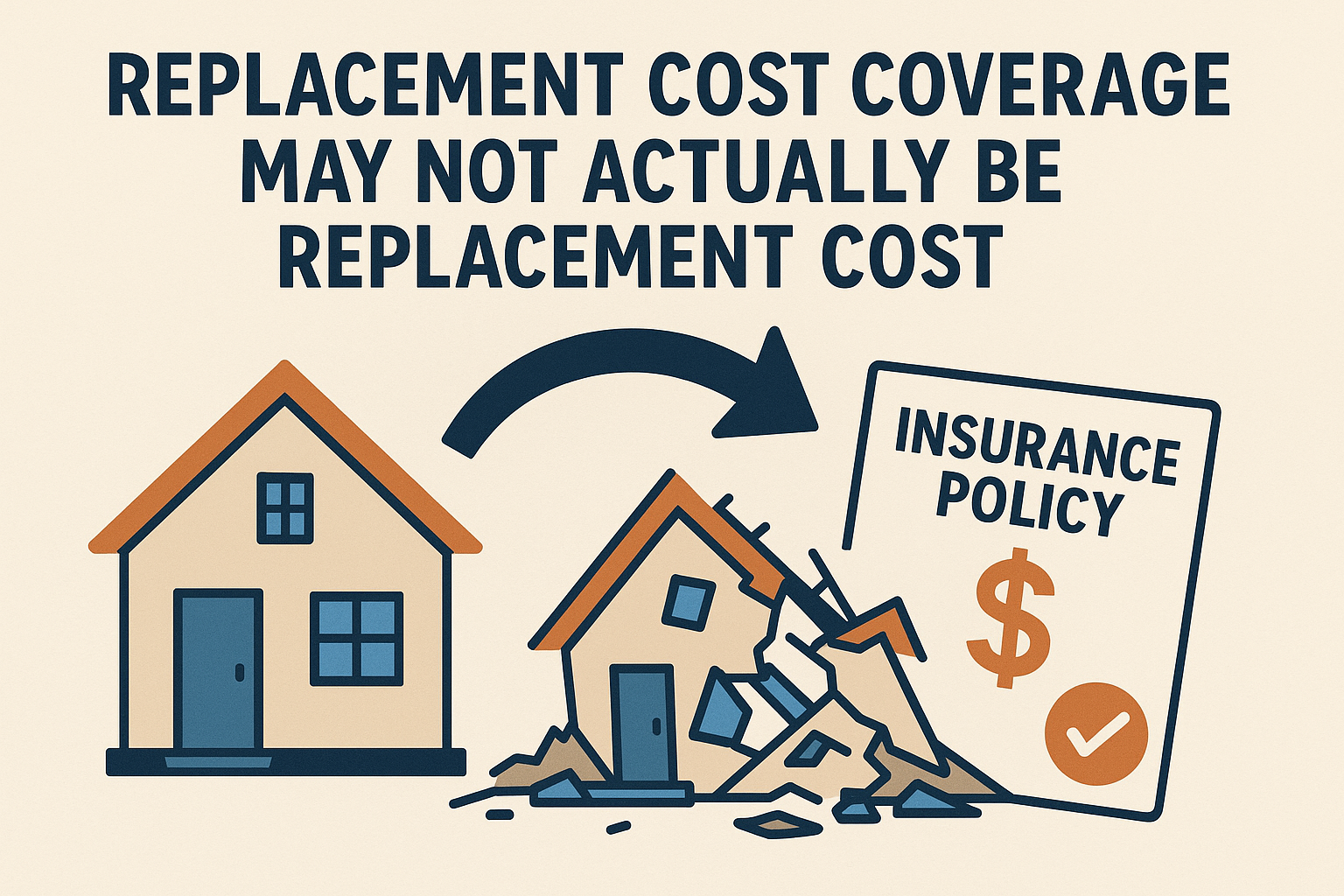
Buying a home is one of the biggest investments many Floridians ever make. To protect that investment, most owners take out a homeowners insurance policy that promises “replacement cost” coverage. Replacement cost coverage sounds like the insurer will pay whatever it takes to restore damaged property back to the way it was before a covered loss. Unfortunately, recent changes in Florida’s insurance market mean many “replacement cost” policies have hidden limitations. Two common restrictions are limited water damage endorsements and roof payment or reimbursement schedules. These endorsements can drastically reduce the amount your insurer pays after a plumbing leak or a damaged roof, leaving you with unexpected bills. This post explains how these policy changes work, why they’ve become more common, and what you can do to protect yourself.
What Does Replacement Cost Mean?
Traditionally, homeowners insurance offered two ways to settle a claim:
-
Actual Cash Value (ACV) — ACV coverage pays the cost to repair or replace the damaged property minus depreciation for age and wear. For example, if your 15‑year‑old roof needs to be replaced, an ACV policy values the roof as a 15‑year‑old roof, not a brand‑new one. Because roofs and building materials wear out over time, the check you receive will be less than the cost of a full replacement.
-
Replacement Cost Value (RCV) — RCV coverage pays the cost to repair or replace the damaged property with materials of like kind and quality without deducting for depreciation. In Florida, insurers may initially pay only the ACV and then release the hold‑back amount when the repairs are completed flsenate.gov. In theory, RCV coverage should fully pay to restore your home, but only if the policy does not contain other restrictions.
Many Florida homeowners believe they have RCV coverage, but a closer look at the policy shows endorsements that significantly limit payouts. The two most significant are limited water damage endorsements and roof payment or reimbursement schedules.
Limited Water Damage Endorsements: A $10,000 Cap on Some Claims
Water damage is one of the most common reasons Florida homeowners file insurance claims. Burst pipes, failed water heaters, or sewer backups can cause thousands of dollars in repairs, including replacing floors, cabinets, and walls. To limit their exposure to these costly claims, some insurers have added limited water damage endorsements, especially on older homes. Here’s what you need to know:
A Cap on Coverage
The endorsement usually adds a limit of liability of $10,000 per occurrence for certain water losses. A Florida appellate decision explains that the policy in that case excluded coverage for water damage below ground or from sewer backups and that the Limited Water Damage Coverage Endorsement only provided $10,000 of coverage for direct damage abbeyadams.com. This cap applies to the entire loss, including tearing out walls or floors to access plumbing, and the court confirmed that tear‑out costs are part of the water damage loss abbeyadams.com. Other legal analyses note that homeowners’ carriers often include these endorsements on homes built before 1975 because cast‑iron pipes are prone to corrosion and failure; the endorsements limit not only damage but also exclude coverage for tear‑out in some situations*csklegal.com*.
Sudden and Accidental Plumbing Only
Limited water endorsements typically apply to sudden and accidental discharges of water or steam from a plumbing system, heating or air‑conditioning system, fire sprinkler, or household appliance abbeyadams.com. They do not cover gradual leaks or water that enters from outside the plumbing system. Importantly, they do not cover water damage from roof leaks, rain coming through storm‑damaged roofs, or floodwater. A blog from a Florida insurance agency notes that some limited water endorsements only cover water damage from plumbing or appliances and exclude damage from leaky roofs ricciinsurancegroup.com. Because Florida sees frequent summer storms, these exclusions mean many water problems will not trigger the endorsement.
Why Insurers Use Them
Insurers say limited water endorsements help keep premiums affordable for older homes. However, the result is that owners of houses with older plumbing may face huge out‑of‑pocket costs when a pipe bursts. The Krapf Legal firm explains that limited water damage coverage provides lower reimbursement and stricter conditions than full water coverage krapflegal.com. Homeowners who choose the limited endorsement pay lower premiums but must accept a much smaller claim payment.
Court Cases Uphold the Limits
Florida courts have generally upheld these $10,000 caps. In Koss v. Florida Insurance Guaranty Association (2025), the court held that because the policy contained a broad exclusion for water damage from sewage or any substance on or below ground, the limited endorsement’s $10,000 limit was the only available coverage abbeyadams.com. The court also found that tear‑out costs are included in water damage and are not separately covered when the loss is excluded abbeyadams.com. Other appellate decisions reached similar conclusions csklegal.com. In short, if your policy has a limited water damage endorsement, you might receive only $10,000 even if actual repairs cost many times that amount.
Roof Payment Schedules and Roof Reimbursement Schedules
Roof damage from wind or hail is another major source of insurance claims in Florida. Historically, most policies covered roof replacements at replacement cost, meaning the insurer paid for a new roof of similar materials. But in the last few years insurers have moved toward actual cash value (ACV) coverage or roof surface payment schedules, which reduce the payout based on the roof’s age and material.
Roof Payment Schedules: A Sliding Scale of Coverage
A roof payment schedule, also called a roof surface payment schedule or roof reimbursement schedule, lists percentages the insurer will pay toward a roof replacement based on the roof’s age and sometimes the material. For example, one independent insurance agent explains that a typical schedule might pay 100 % of replacement cost for a roof less than five years old, 80 % when it is six to ten years old, 60 % at eleven to fifteen years, 40 % at sixteen to twenty years, and 20 % once the roof is older than twenty years blanchardinsurance.com. Another agency’s example uses a similar sliding scale: a 20‑year‑old roof costing $20,000 to replace might result in a payment of only $5,000 carterfamilyinsurance.com.
The company Kin Insurance, which operates in Florida, gives more detailed percentages based on roof materials. Its roof surfacing schedule reduces coverage after the roof is a certain age and shows that metal roofs may only receive 30 % of replacement cost after 30 years, tile roofs 60 %, and asphalt shingle roofs only about 75 % after 19 years kin.com. Kin notes that without the schedule a roof would be covered at replacement cost; the schedule is an optional endorsement that lowers premiums but also lowers payouts kin.com. In a sample calculation, a 12‑year‑old shingle roof costing $15,000 to replace would receive only $7,800 because the schedule reduced the claim by 48 % kin.com.
Why Are These Schedules Appearing?
Insurers argue that paying full replacement cost for older roofs encourages fraud and unnecessary claims. In 2021 the Florida Legislature passed Senate Bill 76 (now part of the law) which, among other things, aimed to curb roofing claim solicitation and limited contractors’ ability to offer incentives for insurance claims floridapace.gov. A year later Senate Bill 2D prohibited insurers from denying coverage solely because a roof is under fifteen years old and allowed homeowners with older roofs to get an inspection showing at least five years of life floridapace.gov. While these laws tried to balance consumer protection and rising insurance costs, insurers continued to ask for more tools to manage roof risks. The roof payment schedule is one such tool: it lowers payouts on older roofs in exchange for lower premiums.
Proposed 2025 Legislation: Roof Covering Reimbursement Schedule
In early 2025, Florida lawmakers introduced Senate Bill 1746, which would amend the existing replacement cost statute to explicitly allow insurers to include a roof covering reimbursement schedule in a policy flsenate.gov. The bill requires that the schedule:
-
Provide full replacement coverage for any roof less than ten years old flsenate.gov.
-
For older roofs, set minimum reimbursement percentages---at least 70 % for metal roofs, 40 % for concrete or clay tile roofs, 40 % for wood shake or shingle roofs, and 25 % for all other types flsenate.gov.
-
Include a conspicuous notice telling policyholders that they are electing to receive reimbursement according to the schedule and that they might have to pay significant costs to repair or replace their roof flsenate.gov.
-
Not apply if the entire structure is a total loss flsenate.gov.
As of the writing of this post (August 24 2025), SB 1746 has been filed but not yet enacted. Nevertheless, it signals legislators’ willingness to formalize roof reimbursement schedules. If enacted, it would require insurers to provide clear disclosure and ensure minimum reimbursement percentages, but it would still allow significantly reduced payouts for older roofs.
High Roof Deductibles and Other Policy Changes
In addition to payment schedules, some Florida policies include separate roof deductibles for wind or hail damage. One insurance blog notes that homeowners with older roofs may have deductibles equal to a percentage of the roof’s value, meaning a 5 % deductible on a $20,000 roof is $1,000, which further reduces what the insurer pays carterfamilyinsurance.com. These deductibles may also apply before the roof schedule percentage is calculated, leaving homeowners with little left over.
Florida’s 15‑Year Roof Rule and Matching Statute
While insurers are allowed to use schedules, Florida law offers some protections. Florida Statute § 627.7011 requires insurers to offer replacement cost coverage and states that an insurer cannot refuse to issue or renew a policy solely because a roof is under fifteen years old flsenate.gov. For roofs fifteen years or older, the insurer must allow the homeowner to get an inspection; if the roof has at least five years of useful life remaining, the insurer cannot deny coverage based solely on age floridapace.gov.
Another important protection is Florida’s matching statute (Fla. Stat. § 626.9744). When a policy is based on replacement cost, and part of a building is damaged, insurers must make reasonable repairs or replacement of items in adjoining areas so that the repaired area matches in quality, color, and size propertyinsurancecoveragelaw.com. For example, if a storm damages half of your roof, the insurer may need to replace undamaged shingles so that the entire roof matches. Homeowners sometimes overlook this statute, but it can make a big difference in what insurers must pay.
How to Protect Yourself
Insurance policies are legal contracts, and the fine print matters. Here are steps Central Florida homeowners can take to avoid unpleasant surprises:
-
Review Your Policy — Don’t assume you have full replacement cost coverage just because the declarations page says “replacement cost.” Check for endorsements titled “Limited Water Damage Coverage,” “Actual Cash Value Roof,” “Roof Payment Schedule,” or “Roof Reimbursement Schedule.” If you’re not sure what an endorsement means, ask your agent or an experienced contractor.
-
Understand Water Limitations — If your policy has a limited water damage endorsement, remember that the coverage cap is usually $10,000 abbeyadams.com. Consider whether that amount would cover the cost to tear out flooring, cabinets, and walls to repair a burst pipe. If not, ask your agent about adding broader coverage.
-
Know Your Roof’s Age and Condition — Insurers base payment schedules and renewal decisions on roof age. Maintain your roof and keep records of installations and repairs. If your roof is over fifteen years old, you may need an inspection showing at least five more years of life to avoid non‑renewal floridapace.gov.
-
Weigh Premium Savings Against Risk — Roof payment schedules and limited water endorsements often lower premiums. But saving a few hundred dollars a year could cost tens of thousands if a hurricane or pipe burst forces a major repair. Carefully compare the cost difference and ask yourself if you can afford to pay the uncovered portion.
-
Take Advantage of Matching and Ordinance Coverage — Make sure your policy includes adequate Law & Ordinance coverage to pay for required code upgrades, such as hurricane straps and secondary water barriers floridapace.gov. Familiarize yourself with the matching statute so you can demand a uniform repair if part of your roof or siding is damaged propertyinsurancecoveragelaw.com.
-
Consult Professionals — Experienced contractors and public adjusters can help interpret policy language and estimate repair costs. Orange Contracting and Roofing has extensive experience with Central Florida homes and can inspect your roof, assess storm damage, and help you understand what your policy might actually pay.
Don’t Wait Until After the Storm
Florida’s insurance landscape is changing rapidly. Rising claim costs, carrier insolvencies, and legislative reforms have prompted insurers to modify policies in ways most homeowners never anticipate. The addition of limited water damage endorsements means a burst pipe could leave you with tens of thousands of dollars in uncovered repairs. Roof payment schedules can reduce coverage for older roofs to a fraction of replacement cost. Proposed legislation in 2025 seeks to formalize these schedules and set minimum percentages but would still allow significant reductions flsenate.gov.
To avoid unexpected out‑of‑pocket costs, educate yourself now. Review your policy, ask your agent questions, and consider whether the premium savings from limited endorsements are worth the risk. Maintaining your roof and plumbing, keeping documentation, and ensuring you have enough law & ordinance coverage can help. Most importantly, if you are unsure what coverage you have or what your policy language means, call Orange Contracting and Roofing today. Our knowledgeable team can evaluate your roof, explain how recent policy changes might affect you, and help you protect your most valuable asset. Don’t wait until after the storm to find out that your “replacement cost” policy doesn’t actually give you replacement cost.
Call Orange Contracting and Roofing at 407-205-2676 or email [email protected]
The company’s office is located at 105 Candace Dr., Suite 129, Maitland, FL 32751.