
If you’ve noticed your roof starting to look faded, chalky, or thin on granules — but a contractor tells you it’s not quite time to replace it yet — you’re in a frustrating middle zone that a lot of Florida homeowners know well. The roof isn’t done, but it’s clearly not healthy either.
There’s a category of treatment gaining real traction in the roofing industry that’s worth knowing about: soy-based shingle rejuvenation. It’s not a coating in the traditional sense, and it’s not a gimmick. It’s rooted in legitimate materials science, it’s specifically designed for asphalt shingles, and when applied to the right roof at the right time, the research suggests it can meaningfully extend the life of a shingle roof at a fraction of the cost of replacement.
Here’s what Florida homeowners should understand before making any decisions.
Why Asphalt Shingles Age the Way They Do
To understand why soy-based treatments work, it helps to understand what’s actually happening when an asphalt shingle roof ages.
Asphalt shingles are petroleum-based products. The asphalt layer that holds the granules in place and provides waterproofing naturally contains oils — and those oils are what give new shingles their flexibility. A fresh shingle bends. It moves with thermal expansion. It sheds water efficiently.
As the roof ages, UV radiation, heat cycling, and environmental exposure cause those oils to evaporate out of the shingle matrix. What you’re left with is a progressively drier, more brittle material. Dry shingles crack. They curl at the edges. They lose granule adhesion, which is why you start seeing grit accumulating in your gutters. And once a shingle is brittle enough, it can no longer flex with temperature changes — meaning cold nights cause cracking in shingles that spent all summer baking in the Florida sun.
In Florida, this process is accelerated. We have more UV exposure, more heat, and more dramatic daily temperature swings than most of the country. A shingle rated for 25–30 years in a northern climate may realistically last 15–20 here, depending on the product, roof pitch, and orientation.
What Soy-Based Rejuvenation Actually Does
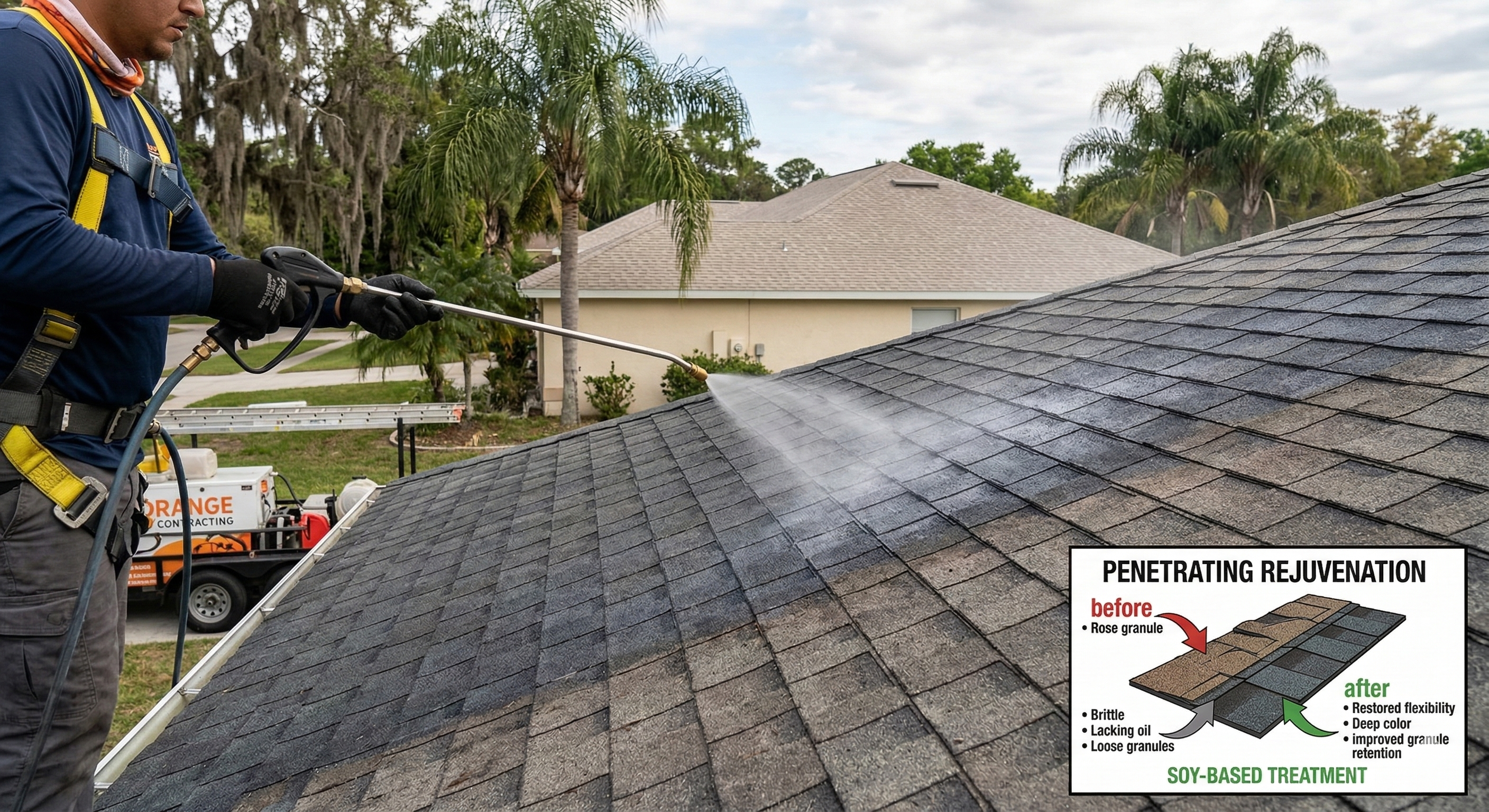
Soy-based shingle treatments work differently from surface coatings. Products like Fresh Roof (which uses a patented GreenSoy Technology formula) and Soyfuze are formulated to penetrate the asphalt matrix and replenish the oils that have been lost — working from the inside out rather than sitting on top of the shingle surface.
Unlike traditional coatings that stay at the surface, soy-based treatments dive deep through the shingle, fusing into the asphalt so the oil won’t rinse away. This makes them a genuine shingle revitalizer, not just a surface treatment.
The active ingredient is a derivative of soybean oil — specifically processed into a form small enough to penetrate the dense asphalt matrix. It’s engineered to restore flexibility, replenish lost oils, improve granule retention, and enhance hydrophobicity. Worth noting: these products are not just raw soybean oil. They include dispersants, polymers, and emulsifiers that allow the treatment to work at a molecular level. Don’t put soybean oil from your kitchen on your roof.
The science has been independently validated. Ohio State University confirmed that soy-based treatments are effective and economical, and the USDA has certified this class of products as biobased. Independent accelerated testing by PRI Materials Testing Labs found significant performance differences between treated and untreated shingles:
- Treated shingles performed 10.8 times better on mass loss — losing just 0.5% of material compared to 5.4% for untreated shingles under the same conditions.
- On UV oxidation after 1,500 hours of accelerated exposure, treated shingles showed just a 7.8% increase in the carbonyl index vs. 30.7% for untreated — meaning the sun does measurably less damage.
- Treated shingles also showed improved low-temperature flexibility after the same UV exposure.
These aren’t marketing numbers — they’re materials test data.
How Long Can a Treatment Extend Your Roof’s Life?
A typical treatment schedule runs every 5–10 years, with up to three applications possible — adding up to 15 years of additional life to a qualifying roof.
Fresh Roof’s GreenSoy formula carries a minimum 6-year lifespan guarantee per treatment. The key point is that this isn’t a one-time fix — it’s a maintenance approach, similar in concept to how you’d treat any other surface that’s subject to weathering and depletion over time.
The economic case is compelling. One treatment typically costs roughly 10–15% of the cost of a full roof replacement, depending on roof size and pitch. If two or three treatments can delay replacement by a decade or more, the math works strongly in a homeowner’s favor — especially given current roofing material and labor costs in Florida’s market.
What Makes a Roof a Good Candidate
Soy-based rejuvenation is not appropriate for every roof. These treatments work best when:
- The roof is made of asphalt shingles — the large majority of Central Florida residential roofs fall in this category
- The shingles are aging but structurally sound — showing signs of oil depletion, surface chalking, or early granule loss, but without active leaks, significant missing shingles, or severely curled material
- The roof deck is intact — treatments address shingle health, not underlying structural issues
- The roof is roughly 7–20 years old, past early life but before complete failure
If you have active leaks or missing shingles, those need to be addressed through repairs or replacement first. A soy-based treatment is not a repair for a failing roof — it’s a maintenance strategy for one that still has structural life left in it.
A professional inspection is the necessary first step. A good contractor won’t recommend treatment without actually assessing whether your roof’s condition warrants it.
Why Florida Roofs Are Especially Good Candidates
The mechanism that soy rejuvenation addresses — oil depletion driven by UV exposure and thermal stress — is exactly what Florida’s climate accelerates most aggressively.
The combination of intense daily sun, high humidity, and the thermal cycling between warm nights and very hot afternoons puts Florida shingles through more stress per year than almost anywhere else in the country. That means Florida roofs tend to reach the optimal treatment window faster, and they have more to gain from it — because accelerated oil depletion is precisely the problem being solved.
When independent testing shows treated shingles retaining 10x more mass and suffering 75% less UV oxidation damage, the implications for a Florida roof that gets 230+ sunny days a year are significant.
What the Application Process Looks Like
Soy-based shingle rejuvenation is a relatively fast, low-disruption process compared to most roofing work:
- Roof inspection — Verifying the shingles are appropriate candidates and identifying any areas that need repair before treatment.
- Surface preparation — Cleaning the roof to ensure the treatment can penetrate evenly, including clearing organic growth and debris.
- Application — The treatment is applied with an airless sprayer, low-pressure softwash, or backpack sprayer. It absorbs quickly — the majority of protective properties form within the first 24 hours, with full internal absorption complete in about three days.
- Post-treatment check — Verifying coverage and noting any areas of concern for future monitoring.
The process can typically be completed in a day with no tear-off, debris removal, or structural disruption to your home.
Safety and Environmental Profile
Soy-based rejuvenation products have a strong safety and environmental profile. Fresh Roof’s GreenSoy formula is 96% USDA certified biobased and non-toxic — safe for people, pets, and plants, with no concern about overspray or toxic runoff around your home.
The sustainability dimension matters too. The U.S. generates more than 11 million tons of asphalt shingle waste bound for landfill each year. Every roof that can be extended by a decade rather than torn off and replaced is thousands of pounds of material kept out of the waste stream — accomplished using a plant-based oil rather than additional petroleum products.
What to Watch Out For
Not all products marketed as “roof treatments” or “roof sprays” are created equal. There’s a spectrum out there — from legitimate soy-based penetrating rejuvenators backed by independent materials testing, to nano-spray products and sealants that make large promises with considerably less science behind them.
When evaluating any roof treatment product or contractor, ask specifically:
- Is this a penetrating treatment or a surface coating? For asphalt shingles, you want a penetrating rejuvenator that restores shingle health from the inside.
- Is there independent third-party testing — PRI, ASTM standards, or university research — supporting the claims?
- Does the product carry USDA biobased certification or EPA Safer Chemicals designation?
- What is the warranty on both the product and the labor?
- Will the contractor do a written roof condition assessment before recommending treatment?
A contractor who can answer these questions clearly, and who won’t recommend treatment before inspecting your roof in person, is worth your time. Anyone selling from a truck without an inspection is not.
Where This Fits in Your Roof Maintenance Picture
Shingle rejuvenation doesn’t replace routine maintenance, regular inspections, or timely repairs. It also doesn’t save a roof that’s genuinely past end of life. What it does is create a legitimate maintenance option that addresses the actual biological mechanism of shingle aging — at a cost that’s accessible compared to full replacement.
For Central Florida homeowners watching the clock on a roof that still has structural integrity but showing its age, that’s a meaningful option to have on the table.
If you’re not sure where your roof currently stands, our Florida Roof Lifespan Calculator is a good starting point. It’ll give you a practical estimate based on your roof type, age, and condition — and help you figure out whether you’re in the window where a treatment like this makes sense, or whether you’re looking at a different conversation.
We’re actively ramping up our infrastructure to provide this valuable service for our Central Florida customers. If you have questions about your roof’s current condition or want a professional assessment of where you stand, reach out to our team. We’ll give you a straight answer.
Orange Contracting and Roofing is a licensed Central Florida contractor specializing in insurance restoration, roofing, and storm damage repair. Learn more at myorangecontracting.com.