
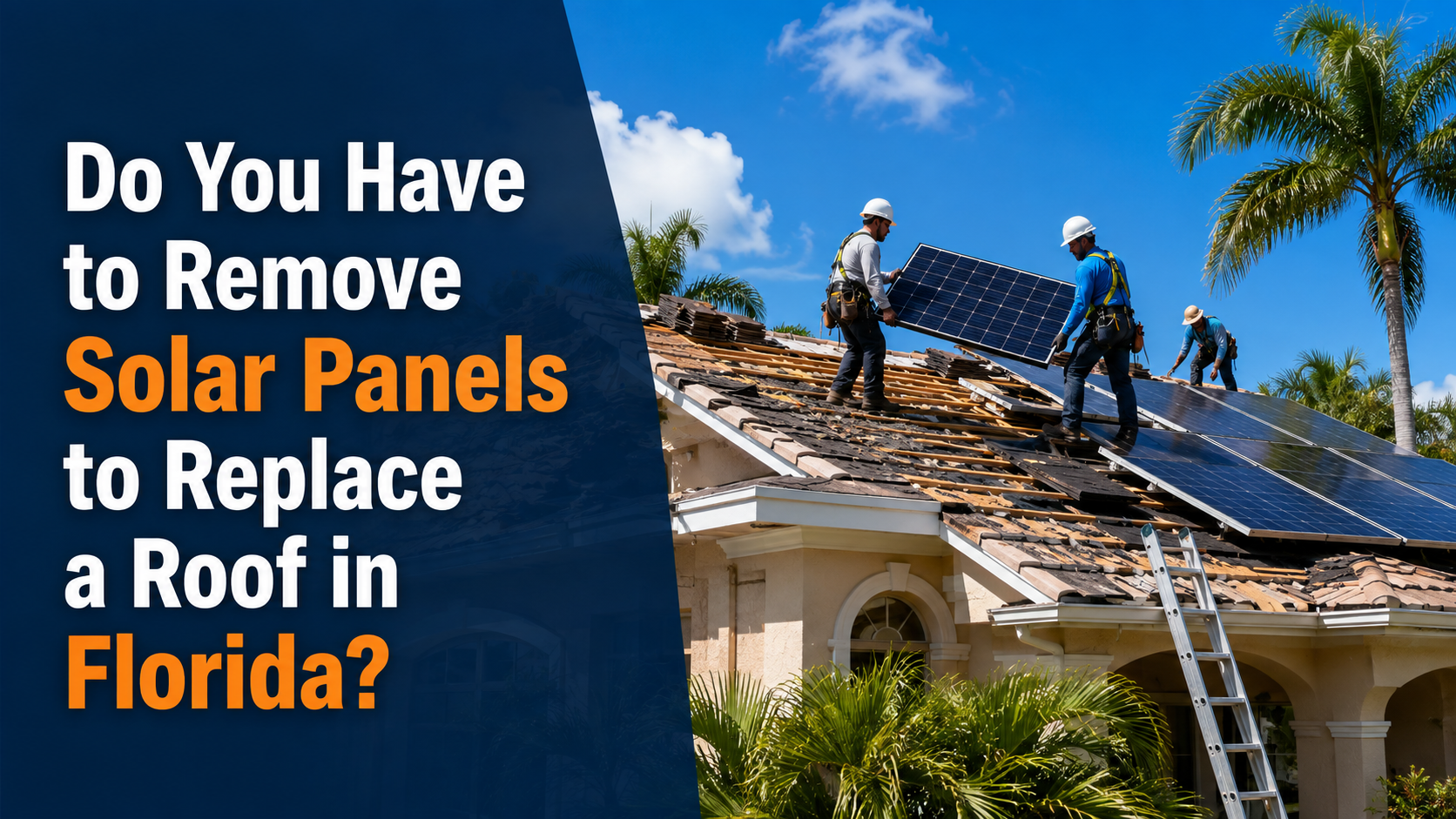
Short answer: yes. If your roof is being replaced, the solar array has to come off first and go back on after. There is no way to reroof underneath panels. The process is called a detach and reset, it typically adds $2,500 to $8,000 to a Central Florida roof replacement, and — this is the part most homeowners get wrong — your roofing contractor is not legally permitted to disconnect and reconnect the system on their own roofing license.
That last point is where most of the trouble starts. Here’s the whole picture, in the order you’ll actually run into it.
Why the Panels Can’t Stay On
Homeowners ask this constantly, and it’s a fair question — the panels only cover part of the roof, so why not work around them?
Because a roof replacement is a tear-off. Every shingle, every layer of underlayment, and often sections of decking come off down to the bare structure. The racking that holds your array is lag-bolted through the shingles into the rafters or the deck itself. Those penetrations are part of the roof assembly being removed.
Working around an array also creates three problems no reputable contractor will accept:
- You can’t replace underlayment under a panel. Whatever is beneath the array stays original — which means the oldest, most sun-baked portion of your roof system stays in place under the newest part. That’s a leak waiting to happen, and it’s the section you can least easily access later.
- The old mounting penetrations stay open or get patched blind. Proper practice is to seal every abandoned bolt hole at the deck and flash the new mounts cleanly into the new roof. That can’t happen if the hardware never comes off.
- Nobody will warranty it. Manufacturer system warranties and contractor workmanship warranties both generally exclude areas that weren’t fully replaced. You’d be buying a new roof with a permanent asterisk on it.
There’s one narrow exception: an isolated repair on a section of roof well away from the array — a pipe boot replacement on the opposite slope, say — usually doesn’t require touching the panels. A full replacement always does. If you’re not yet sure which situation you’re in, our guide to roof repair versus full replacement in Florida works through that decision.
Who Is Actually Allowed to Touch Your Array
This is the single most important thing in this article, and it’s the thing that most often costs Florida homeowners money.
Under Florida Statute §489.105(3)(o), the installation, alteration, repair, relocation, or replacement of photovoltaic panels and their associated equipment falls within the scope of a solar contractor. Your array is also an active, grid-interconnected electrical system — disconnecting it, reconnecting it, and getting the reinstall permitted and inspected is licensed electrical and solar work.
A roofing contractor license, by itself, does not authorize that work. A roofing license covers the roof assembly and its waterproofing integrity — not your inverter, your rapid-shutdown devices, or your utility interconnection.
What this means practically:
A roofer who offers to “just pop the panels off for you” as a favor is a red flag. It sounds like they’re saving you money. What they’re actually doing is performing unlicensed work on a live electrical system, which puts your manufacturer warranty, your permit, and potentially your homeowners coverage at risk.
Unlicensed detach-and-reset has become a real cottage industry in Central Florida, driven by the simple math that Florida roofs wear out faster than the 25-year solar systems bolted to them. Verify credentials yourself before anyone touches your array — the state’s DBPR license lookup is free and takes two minutes. You’re looking for a CVC (solar) or EC (electrical) license on whoever is handling the panels, and a CCC or CGC on whoever is handling the roof.
The right structure is one accountable contractor coordinating both trades under a single schedule — so that when the roof is done and the panels go back up, there’s no argument about whose bolt caused the leak.
The Detach-and-Reset Sequence
When it’s done properly, a reroof with solar follows a fixed order. Knowing the sequence lets you tell whether a proposal is serious:
- System assessment. Panel count, racking type, inverter configuration, mounting method, and roof material are documented before anything is scheduled. Photos of the existing layout matter — the array should go back exactly where it was, both for production and for any prior HOA or permit approval.
- Utility and monitoring notification. Your system is coming offline. Depending on your utility and interconnection agreement, notice may be required.
- Shutdown and detach. The array is de-energized following proper procedure, panels and racking come off, and everything is labeled and stored on site or off site.
- Deck penetrations sealed. Every abandoned mount hole gets sealed at the deck immediately — not left open overnight in August in Florida.
- Roof replacement. Tear-off, deck inspection and re-nail, new underlayment, new roof covering. This is also the moment to get your secondary water barrier right, since the array will be back on top of it for the next two decades. (We cover the options in detail in our post on roof underlayment in Florida.)
- Roofing permit final. The reinstall should happen after the roofing permit passes final inspection, not before.
- Reinstall, reconnect, re-permit. New flashings and mounts, panels reset, system reconnected, and the solar work permitted and inspected on its own permit.
- Production verification. Confirm the system is actually producing at expected output before final payment. Get this in writing.
Realistic timeline: the array is typically off the roof for one to three weeks on a standard residential job, depending on roof size and inspection scheduling. Your lost solar production during that window is usually a few dollars a day — a rounding error compared to the cost of doing this wrong.
What It Costs in Central Florida
Detach-and-reset pricing varies more than almost any other roofing line item, because it depends on panel count, roof pitch, racking age, and whether the original installer is still in business.
| Component | Typical Central Florida range |
|---|---|
| Detach and reset, per panel | $150 – $400 |
| Typical 20-panel residential array | $3,000 – $8,000 |
| Solar reinstall permit | $150 – $500 (varies by jurisdiction) |
| New flashings / mounting hardware | $200 – $800 |
| Utility disconnect/reconnect fee (if applicable) | $0 – $600 |
A few cost drivers worth knowing about:
- Racking age. Hardware more than ten years old corrodes, and corroded lag bolts take significantly longer to back out without damaging the deck. Older systems commonly run 25–40% more in labor.
- Original installer status. If the company that installed your system is still operating, they’re often the cheapest and cleanest option because they know the hardware. A large share of Florida solar installers from the 2018–2022 boom are no longer in business, which is why so many homeowners find themselves stuck between trades.
- Tile roofs. Detach-and-reset on tile costs meaningfully more than on shingle, because the mounts, flashings, and tile replacement around each penetration are all more involved.
Ranges above reflect typical Central Florida market pricing and are for planning purposes. Your actual cost depends on your specific system and roof.
When Insurance Pays for the Detach and Reset
Here’s where our perspective differs from a typical roofing company’s.
If your roof is being replaced because of covered storm damage — not age, not wear — the detach and reset is generally part of the cost of repairing the covered loss. You cannot replace the damaged roof without removing the array, which makes panel removal and reinstallation a necessary component of the repair rather than an optional upgrade.
Carriers don’t always include it on the first estimate. Detach-and-reset is a line item that gets omitted routinely, sometimes because the field adjuster’s scope notes never mentioned solar at all. When it’s missing from a $22,000 roof estimate, that’s a $5,000 gap coming out of the homeowner’s pocket for work that has to happen.
What to do about it:
- Photograph the array before anything moves. Panel count, layout, racking, inverter, and the roof condition around the mounts.
- Make sure the array appears in the adjuster’s scope. If the estimate doesn’t name it, it isn’t in the number.
- Get the detach-and-reset quoted separately and in writing so it can be submitted as a documented supplement rather than an argument.
- Don’t authorize work before you understand what’s covered. Once the panels are down, your leverage to document the pre-loss condition is gone.
If your carrier’s estimate came back short and you’re not sure whether the shortfall is legitimate, our sister firm NeJame Claims Adjusting handles exactly this kind of scope dispute as licensed Florida public adjusters. It’s also worth reading our guide on why Florida roof insurance payouts fall short — omitted line items like this are one of the most common causes.
For age-related replacements, the detach and reset is simply part of your project cost. Budget for it from the start rather than discovering it after you’ve signed a roofing contract.
The Planning Point Nobody Tells You
If your roof is within about five years of the end of its service life, replace the roof before you install solar.
Solar systems run 25 to 30 years. Central Florida asphalt shingle roofs often don’t make it past 15 to 20 under our UV load, heat, and storm cycles. Installing a $25,000 array on a 14-year-old roof guarantees you’ll pay for a detach and reset — plus the coordination headache — well inside the system’s life.
If you’re weighing a solar installation right now and aren’t sure where your roof stands, run it through our free Florida Roof Lifespan Calculator before you sign anything with a solar company. Five minutes of arithmetic can save you five figures.
The same logic applies if you’re selling. A buyer’s inspector who flags an aging roof under an array creates a much harder negotiation than an aging roof alone, because the buyer now sees two expenses stacked together. Our post on replacing a roof before selling walks through when that math works.
Frequently Asked Questions
Can a roofing contractor remove my solar panels? Not on a roofing license alone. Disconnecting and reconnecting a photovoltaic system, and permitting the reinstall, is solar or electrical contractor scope under Florida Statute §489.105. A roofing contractor can and should handle the roof itself, and should coordinate the licensed solar work — but a roofer offering to detach your array personally as part of the roofing scope is a signal to verify licensure before proceeding.
Do I need a permit to reinstall solar panels after a new roof? Yes. Removing the panels generally doesn’t require its own permit, but reinstalling does — you’re re-establishing structural attachments to the building and reconnecting a grid-tied electrical system. That permit is pulled by the licensed solar or electrical contractor, separate from the roofing permit.
Will removing my panels void the solar warranty? It can, if the work is done by someone unqualified. Most manufacturer and workmanship warranties require that service be performed by appropriately licensed technicians. Detach-and-reset by a licensed solar contractor typically preserves coverage; a handyman or an unlicensed roofing crew typically does not. Check your specific warranty terms before scheduling.
How long will my solar system be offline? Usually one to three weeks on a standard residential reroof, driven mostly by inspection scheduling rather than labor. During that window you’re on full utility power. The production loss is generally a few dollars per day.
Does insurance cover solar panel removal after storm damage? When the roof replacement itself is a covered loss, the detach and reset is generally recoverable as part of the necessary repair — but it’s frequently left off the carrier’s initial estimate. Document the array before work begins and confirm it’s included in the approved scope.
Should I replace my roof before installing solar? If the roof has less than five to seven years of remaining service life, yes. It’s far cheaper to reroof first than to pay for a detach and reset a few years into the system’s life.
Working With a Contractor Who Understands Both Sides
A reroof with solar is a coordination problem more than a technical one. The failure mode is almost always the same: two trades, two schedules, two permits, and nobody owning the seam between them. Then a leak shows up around a mount six months later and the roofer blames the solar company while the solar company blames the roofer.
At Orange Contracting, we handle the roofing scope and coordinate the licensed solar detach and reset as part of a single project schedule — so the sequencing, the permits, and the responsibility are all in one place. And because we hold public adjusting credentials in-house, we can tell you up front whether your detach-and-reset belongs on an insurance claim or on your own budget, before you commit to anything.
If you want a starting number for the roofing side, our free Instant Estimate tool gives you a satellite-based price range in under a minute. When you’re ready to talk through your specific array and roof, contact us to schedule an inspection.
Call us at 407-205-2676 or reach out online.
Orange Contracting and Roofing is a licensed Florida roofing contractor (CCC1337502), residential contractor (CRC1336049), and general contractor (CGC1540193) serving Orange, Seminole, Lake, Osceola, Polk, Volusia, and Brevard Counties. This article is general information about Florida roofing and permitting practice, not legal advice or a coverage determination on any specific policy.